“Revenue is the chief preoccupation of the state. Nay more it is the state” – Edmund Burke I spent the weekend with some old friends from the development sector. One of them, it now turns out, is working for a public relations consultancy. There was an awkward moment when I explained that I was working… Continue reading Oxfam goes for the full Tanzi…but is that far enough?
Author: Martin Hearson
Ireland does spillover analysis: the proof of the pudding will be in the eating
I haven’t blogged for a while, having been away, and as other bloggers will know, it’s all about getting the momentum going. But Tuesday’s announcement by the Irish government, news of which came via Christian Aid’s Twitter feed, has spurred me into action! Ireland has decided “to undertake a ‘spillover analysis’ to research what impact,… Continue reading Ireland does spillover analysis: the proof of the pudding will be in the eating
Legislative scrutiny of tax treaties: compare and contrast the UK and US
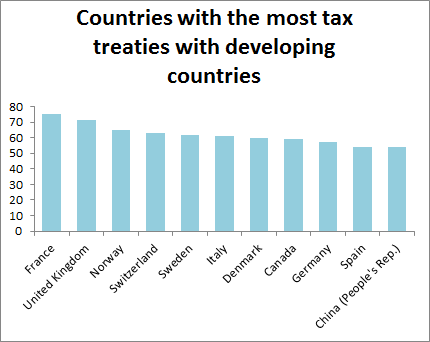
Here’s an interesting chart. Do you notice anyone missing? Interestingly, the United States is considerably less keen on signing tax treaties with developing countries than you might expect, given the amount of investment from it to, well, most places. Its only treaty with the whole of sub-Saharan Africa is with South Africa. When I looked… Continue reading Legislative scrutiny of tax treaties: compare and contrast the UK and US
Tax-motivated illicit financial flows: A guide for development practitioners
January was a busy month and so this is my first blog of 2014. I didn’t intend for my comeback to be a self-promotion post, but that’s how the timing has worked out! Last year I was pleased to be able to work with the U4 anti-corruption centre in Norway on an introductory briefing on… Continue reading Tax-motivated illicit financial flows: A guide for development practitioners
Some academic thoughts on international tax reform
Since my post last week on unitary taxation, I’ve read a couple of academic papers that give useful perspectives on some of the questions I raised. US states and unitary taxation First up, Lessons for International Tax Reform from the U.S. State Experience Under Formulary Apportionment by Kimberly Clausing. One of the concerns I raised… Continue reading Some academic thoughts on international tax reform
Some political questions for Unitary Taxation
It sometimes feels like, when discussing unitary taxation [pdf], one is expected to self-identify as either a UT advocate, interested in how it could be made a reality, or a sceptic, determined to defend the status quo. I’m neither. As a political scientist, I want to understand (among other things) how our international tax instruments… Continue reading Some political questions for Unitary Taxation
 Martin Hearson